
Framing Femicide in the Netherlands
Analysing Media and Audience Discourses on X
co-authored with A. Hamel, D. Houtman, K. de Koning, and S. J. Krabbendam
In the last few months, articles about femicide cases in the Netherlands have increased significantly (NPO Funx 2025; JOOP 2025; Van Spronsen and de Vries 2025). Femicide is a form of violence that affects all women, independent of status, religion or race. Between 2018 and 2022, in 172 out of 217 reported cases of femicide, the perpetrator was found to be someone from the victim’s domestic environment—most often an ex-partner (51 percent) (Rijksoverheid 2024). Since 2022, political attention to femicide has increased, yet the number of cases has not decreased. There has also been a greater focus on improved police recognition of violence and earlier intervention by organisations such as Veilig Thuis. Furthermore, the government launched Stop Femicide! in 2024—an action plan to combat lethal violence against women (Rijksoverheid 2025). It is apparent, however, that these approaches have not led to significant change: this year alone, 26 women had already been killed by August (EWMagazine 2025). The problem of femicide has sparked wide debate and speculation in the Netherlands about its societal impact and root causes. Such discussions are especially lively in online environments like X (formerly known as Twitter), one of the largest social media platforms in the world.
Departing from a social constructivist framework—wherein knowledge, perception and reality are the result of human interaction and sociocultural factors—this paper investigates how social media users on X make sense of femicide causes in their online engagement with Dutch news coverage by NOS of gender-related killings of women in 2025. By zooming in on femicide news coverage and user responses to it, this research aims to provide an interdisciplinary exploration of these social media users’ sense-making of femicide causes in online social networking environments. In this way, we sought to gain a deeper understanding of how the audience’s knowledge about femicide causes is constructed in these mediated producer-consumer interactions. On the media production end, we firstly investigated the framing of femicide by Dutch broadcasting organisation NOS—i.e., how the Dutch news outlet frames causes of femicide in the Netherlands to audiences on X. From a consumer perspective, we looked at what main causes of femicide are conveyed by social media users in their engagement with NOS posts about femicide on X.
The literature review explores the concepts ‘femicide’, ‘structural violence’, ‘symbolic violence’, ‘securitisation’, ‘intersectionality’ and ‘Othering’, which informs our analytical lens. The methodology section elaborates our interdisciplinary approach which combines discourse analysis and digital ethnography. Finally, some research limitations are briefly discussed.
Methodology
Our approach draws from methods that bridge academic strands of anthropology and postcolonial studies to clarify how media production and audience consumption co-construct situated understandings of femicide causes in the Netherlands through exchanges on the social networking service X. To that end, digital ethnography and discourse analysis were combined in an analytical framework following the four-stage model described by Diphoorn et al. (2023): disciplinary grounding, perspective-taking, finding common ground, and integration.
Anthropology is a field of study focused on the sociocultural development and experience of humans (The American Anthropological Association 2025). With the advent of the internet and subsequent proliferation of online community-building, digital ethnography takes the traditional anthropological method of ethnography—typically reliant on in-person investigation—to the digital realm. While it poses unique theoretical, practical and ethical challenges for researchers, it is also a method that lends itself well to experimentation and interdisciplinarity (Dean 2023). Digital ethnography can facilitate fruitful exchanges between theory and practice of the humanities and social sciences—especially when it comes to textual approaches. As such, its ethnographic methods are particularly suitable for researching social media platforms like X, given that user engagement is mostly text-based.[1]
The study of cultural texts lies at the heart of postcolonialism, a field of study focused broadly on the impact of colonialism. Based on the notion that “[discourses] constitute and produce our sense of reality and objects of knowledge,” postcolonial thought explores theories of colonial discourses to look at cultural representations and modes of perception that reflect historical conditions (McLeod 2010, 38). Discourse analysis is a documentary analysis method of the social sciences and humanities that examines the functions of written and spoken language. Particularly, as it affects the construction and interpretation of meaning through social interactions—in this case online—that mirror power dimensions (Hall 1997). In this sense, discourse analysis in postcolonialism addresses “the complicity of knowledge, representation and culture in the operation of power at any given moment and in any specific location” (McLeod 2010, 38).
By combining these methods, our research, on the one hand, offers an ethnographic account of how X users make sense of femicide as reported by Dutch news outlet NOS on the platform. On the other hand, our discourse analysis reveals how knowledge about femicide is discursively pre-shaped through the framings used by this outlet, influencing what users know about the subject and how they understand it. In conjunction, digital ethnography grounds our inquiry in lived online practices, while discourse analysis situates these practices within broader ideological formations. Together, they generate an interdisciplinary and theoretically rigorous understanding of how discourse enacts specific narratives, meanings, and knowledge about femicide among X users in the Netherlands.
[1] From a media studies perspective, images and graphics can also be ‘read’ as texts and are commonly referred to as media texts.
Literature Review
Scholarly discussions of femicide often begin with the recognition that it is not only a crime against individuals, but also a phenomenon rooted in wider social structures. French (2024) defines femicide as “a gendered form of violence that targets women because of their social identity” (90). She stressed that the persistence of femicide, the failures of states to prevent or resolve these crimes, and their underrepresentation in official statistics constitute a global crisis.
Farmer (2004) provides an anthropological explanation for certain persistent forms of harm with the term ‘structural violence’, which he defines as “violence exerted systematically—that is, indirectly—by everyone who belongs to a certain social order” (307). By normalising male dominance, structural violence is collectively sustained by making women’s suffering appear natural rather than socially produced. His concept shares theoretical connections with symbolic violence—where the dominant group imposes their values to make others seem inferior and establish a hierarchy of power between social groups (Glebbeek 2025, 26). Symbolic violence shows the “connection between real-life violent practices and socio-political themes such as power, control, and domination” (Mishra 2022, 3). These dominant actors enforce a form of internalised humiliation that makes disempowered social groups, like women, accept the narratives imposed by those in power (Mishra 2022). The victim-blaming narrative trope is an important example of this: a discursive pattern that contrasts ‘deserving’ and ‘undeserving’ victims based on sexual morality, class, or conformity to patriarchal ideals (Aldrete et al. 2024). In this narrative, blame is shifted away from the actual threat—the perpetrators—and, in the case of femicide, onto women themselves.
It should be noted, however, that social groups are often understood from a reductive perspective wherein social identities are oversimplified and separated from each other. Kimberlé Crenshaw (1989) proposed ‘intersectionality’ to illustrate how social identities overlap and influence each other, resulting in specific forms of marginalisation. Consequently, one must be mindful of how gender-related violence—for example in the case of femicide—might also be linked to other marginalised social identities, such as race and class.
The framing of femicide in the media furthermore tends to reduce the structural dimension to more individualised narratives. Questions of security play a role in this framing. Securitisation is the process through which certain groups or practices are designated as threats to a society (Goldstein 2015, 50). Analogous to this view, Spivak (1985) introduced the term ‘Othering’ to describe how colonial and patriarchal systems create the Other as a way of maintaining power relations. Later, Jensen (2011) expanded on this, defining Othering as a process where the powerful majority create subordinate groups and ascribe inferior characteristics to them (65). This process reinforces superiority and “conditions” how subordinated people see themselves in specific social contexts (63).
Altogether, these processes shape how femicide is made sense of within public discourse. Femicide is increasingly recognised as a form of structural violence tied to entrenched inequalities, as well as symbolic violence tied to themes of power and domination. Furthermore, the media seems to frame certain narratives through tropes of Othering and victim-blaming. This raises important questions about how news audiences interpret such framings.
Findings
Discourse Analysis
The Myth of Neutral Language
On X, NOS shares news items with its audience in posts that include a brief headline and a link to the full article on its website with an accompanying header image. A few characteristics of note stand out about these posts. Firstly, the headlines’ use of passive language—occuring when the subject of a sentence receives the action of the verb instead of performing it—in almost all instances. Such ostensibly neutral phrasing leaves out the act of violence committed against the female victim. The language naming and contextualising the harm with specific, accurate terms is therefore not conveyed to its audiences. This presents gendered victimhood detached from femicide as a broader phenomenon or form of structural violence, but instead as isolated incidents. The header images of the headlines analysed in our study might exacerbate this observed effect. All case-related news items depict photos of crime scenes, showing police presence and investigative procedures. Such imagery further reinforces the idea of violence against women as a matter of (personal) security requiring police intervention, rather than a societal issue maintained by circulating harmful representations, ideas, and attitudes that encourage—symbolic and structural—gendered violence.
Examples from 2025 illustrating passive and neutral language abound, including an article from October titled “Deceased woman found in home in Heerlen, police suspect foul play,” and an earlier one from September labeled “Woman (53) dies after stabbing incident in Groningen, man arrested,” respectively (NOS Nieuws 2025b; 2025c). The articles themselves obfuscate the correlation between actions of perpetrators and the consequence—death—for their victims. To illustrate, the victim’s wounds are mentioned as the cause of death in the second article, rather than the fatal stabbing and killing inflicted by the perpetrator.
NOS often uses supposed neutral terms in its news articles when talking about women who were victimised by men. Editors seemingly choose to refrain from politicised and explicit terms in titles as well as articles to maintain the image of a nuanced and non-biased news source. What happens in doing so, however, might be the exact opposite: it creates an opportunity for readers to speculate—and sometimes confirm their own bias—about these cases. Especially since it is unclear how many users read the full articles, these headlines on their own serve to enact narrow understandings of gender-related violence against women.
The second striking aspect about these posts is the avoidance of the term ‘femicide’. Despite its relevance for the cases discussed, it is never mentioned in any of the articles about gender-related killings. Among the 12 examined articles, only one makes explicit mentions of femicide—not related to any specific case, but in coverage of a women’s march against femicide (NOS Nieuws 2025a). The article quotes women who share their grievances about common victim-blaming narratives that overshadow the role of predominantly male perpetrators. In the article, Klumpenaar, one of the protesters shared how “men too often say: ‘what was that woman doing out alone late at night?’ We have to stop that. You can't blame a woman for being assaulted,” and how, “that discussion really needs to end.” The overarching counternarrative shared by the protesters emphasised the collective responsibility of protecting women and girls’ safety, rather than looking at their individual actions that purportedly lead to their victimisation.
Femicide has accrued connotations that have resulted in the term becoming heavily politicised in the Dutch context. By either not mentioning politicised terms at all or favouring ostensibly neutral language use, news sources enact narrative tropes of victim-blaming. Along with the invidious ideas about women and other minority groups that are put forward by dominant actors, this also further encourages readership speculation about what might have happened in these cases of femicide.
Gendered Victimhood and Racialised Perpetratorhood
The nature of the relationship between the victim and perpetrator, an important aspect of femicide cases, is omitted from most NOS articles. When describing the possible relationship between them, articles often indicate that one exists but do not explain what this relation is exactly (see for example, NOS Nieuws 2025b; 2025c). This creates a certain mystification around the perpetrator’s identity: it is brought to the attention of the reader but also left anonymous and open for interpretation. Statistics from research on femicide have shown that the perpetrator in such cases is most often someone from the close, domestic circle of the victim, while only 26 percent comes from an unknown direction (Rijksoverheid 2025). Despite plenty of public data supporting this finding, our ethnographic observations on X found that readers still often assume the perpetrator to be a male stranger. More specifically, the perpetrator is seen as a male stranger from a foreign country due to popular and public discourse—in politics for example—linking unsafety to themes of migration in the Netherlands.
Mystification thus leaves room for readers to contrive their own conclusions, and, moreover, invoke dominant harmful ideas about minoritised groups—consisting of male immigrants of colour in this dynamic. As a consequence, symbolic violence can enter the stage by implanting dominant ideologies into the interpretation of the reader, which in turn maintains structural violence against this same group. Overall, the framing used in the articles posted by NOS on X discursively stimulates reader speculation about the perpetrator’s identity, who is often alleged to be a male foreigner even when the data shows a different reality. Especially in the current Dutch sociopolitical climate characterised by polarising framing of immigration as a crisis, threat, and hostile to the Dutch way of life (Monika 2025).
When looking more specifically at perpetrators, news articles frequently showcase redeeming qualities placing them in a good light. One article in cooperation with NH, for example, shares how bystanders will say—of the perpetrator—how he “was such a good neighbor,” “someone who was so nice,” and “always said hello” (NOS Nieuws and NH 2025). Personal accounts like these engender feelings of compassion, empathy, and even a sense of victimhood by emphasising their good character. In doing so, the narratives constructed by these news articles foreground the innocence of perpetrators as opposed to culpability, shifting attention away from their violent, fatal deeds.
Treating perpetrators as potential victims (of circumstance) establishes a certain hierarchy in which fatally victimised women are invisibilised and pushed to the background. Besides the female victims in question, the general increased vulnerability of women as a whole—i.e., taken as an entire social group—is by extension downplayed.
Digital Ethnography
Migrant-blaming
A striking number of comments framed femicide as a consequence of migration and open-border policies. Many users immediately assumed that the perpetrator was Muslim or Arab, even though the original post contained no information about his identity. Comments such as “definitely a primate from a backward part of the world” and “the perpetrator is of course one of those with a long beard and a crooked nose” show how racialised stereotypes were used to fill in missing details. Others mocked the EU and immigration policy more broadly: “what a bloody mess in the EU. Get rid of all those people. Then the police will finally have time for the streets,” and “it’s a party every day now, but by all means keep going with open borders and the import of violence”.
These comments reflect symbolic violence, in which dominant groups impose their values to make others appear inferior and maintain hierarchies of power. By portraying migrants as dangerous and uncivilised, commenters reproduce ideas of moral and cultural superiority. In doing so, the commenters portray prejudice as common sense and hereby reinforce the social order that normalises both racialised and gendered forms of harm.
Many responses also connected cases to national politics, linking femicide to the government’s ‘failed’ asylum policies. One wrote, “Make the Netherlands safe again for women and children and close the borders”, while another demanded “a migration dashboard, just like we once had a corona dashboard”. Some used sarcasm to blame ‘left-wing’ actors for allegedly covering up the truth: “The same people who applaud when another batch of young men from Africa and the Middle East arrives. Strange”.
Several comments also targeted NOS—a Dutch public broadcaster—directly, accusing it of censorship or political bias: “NOS leaves this [the Arab appearance of the perpetrator] out of their reporting because they’d rather undermine the police”, and “Incident? Screw off NOS, this is daily news. Perpetrators: the damn Muslims”. ‘This’ here refers to the perpetrator's ethnicity. These reactions shift the focus to migration and national identity.
Victim-blaming
When the blame was not being placed on migrants or Muslims, it was instead directed to the victims. Underneath one post about an 83-year-old woman being stabbed by her own husband, people started to downplay the actions of the perpetrator. One commenter said: “Sad, I think there's more to this than meets the eye”, and another said: “There is probably a huge underlying drama here. Sad, very sad”. There were even comments trying to explicitly blame the woman: “They can be annoying, you know. Ladies like that. But anyway. Now there is a victim to mourn, unlike in the Abcoude case”.
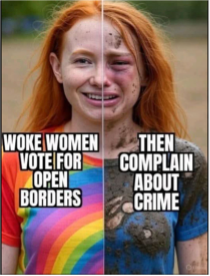
Other women were also blamed for the femicide cases in the news. One user posted an AI-picture (see Picture 1) with the caption: “Even after the countless incidents this week, they refuse to call it by its name. Meanwhile, the stabbings, rapes and cases of honour killings continue unabated,” underneath an NOS post about a protest against femicide. The image on the left side shows a ‘woke woman’ who votes for open borders, and the right side shows the same woman covered in dirt and bruises, complaining about the crimes against her which supposedly result from open border policies. This relates to the blaming of migrants discussed above, but it also puts the blame on women themselves. The user alleges that if women vote for open borders, they should not be surprised when the crime rate against women goes up. One comment “Weak beta males are often dangerous and frequently come from the left-wing climate movement with loose hands indeed. But left-wing women can also get under your skin. A deadly cocktail,”[2] also implied that ‘woke women’ themselves are to blame since they get “under your skin”, which can incite male violence. Another comment, which said: “As if that will help. What we need is a halt to asylum. Why are women/ladies/girls always so naive????” also seems to assert that women are to blame for their own suffering because of their naivety.
Criticism on Neutral Language
In April, a 39-year-old woman had been stabbed to death with NOS referring to it as a ‘stabbing incident’. Most comments condemned this phrasing, and some argued how murders of women happened so often to the point that news outlets frame it as an incident rather than murder. One user wrote: “‘stabbing incident’ Have we sunk so low in this country that we now refer to a terrible event in which someone loses their life as an ‘incident’? In other words: get used to it, this is going to become normal?” This tendency of news outlets to neutralise language reflects broader patterns of symbolic violence where framing (lethal) cases of gender-related violence as mere ‘incidents’ has become normalised, making them seem inevitable.
When examining the articles, one recurring pattern was the use of neutral or depoliticised language. Many readers noticed this as well and voiced their criticism in the comment sections under NOS posts, especially when they refer to murders as ‘incidents’. Some accused the news outlet of downplaying serious cases, writing remarks such as “Get lost with your half-baked ‘newspeak.’ A brutal murder is not a ‘stabbing incident.’” and “You are misspelling murder.” Additionally, news consumers started to use the term ‘femicide’ when referring to the increasing number of murdered women, emphasising the increasing insecurity of women where existing systems that are supposed to offer security continue to fail them. Replies like “STABBING INCIDENT???? It's pure murder! These so-called stabbing incidents are becoming a ‘continuous process,’ happening every single day!,” and, “Died after a stabbing incident? You mean stabbed to death? You mean femicide?” reveal frustration among readers when the news outlet failed to refer to deadly crime as murder, consequently feeding into a broader system where gender-related violence persists.
[2] Tweet has since been deleted.
Conclusion
By integrating discourse analysis and digital ethnography, we examined how news framing and user responses shape public understandings of femicide. Specifically, how social media users on X make sense of causes of femicide in their engagement to Dutch news coverage by NOS of gender-related killings of women in 2025.
Discourse analysis showed that Dutch news outlet NOS often uses passive and neutral language that hides the act of violence and avoids the term ‘femicide’. By describing killings as “incidents” and showing police images, the media frames gender-based violence as a security problem instead of a deeper social issue. This neutral framing—with news outlets trying to stay non-biased—creates space for its readers to speculate, often confirming their own biases about perpetrators and victims.
Digital ethnography showed how many X users linked femicide to migration and open-border policies, using racist language that portrays migrants as a dangerous Other. Such reactions reflect symbolic violence, by portraying migrants as dangerous, uncivilised and inferior—normalising racialised and gendered forms of violence. Victim-blaming was also common, with women held responsible for their own deaths through their actions, relationship choices, or political views. However, some users pushed back against this narrative by referring to gender-related harm as femicide and criticising the media for downplaying violence, calling attention to how such framing normalises gender-based violence.
When conditions arise where readers get the opportunity to determine the culpable actor—in cases of femicide, sometimes the perpetrator and sometimes the victim, or both— stereotypes, mostly of minoritised social groups, become the familiar repertoire to provide answers. This pattern also illustrates the relevance of intersectionality to understand constructions of victimhood and perpetratorhood. When looking at reader engagement, it becomes apparent that the dominant understanding of femicide constructs the victim as a white female set against a male perpetrator with a migrant background. Thus, it becomes evident in replies on X that men of colour are scapegoated as the root cause of violence against (white) women, which simultaneously enhances both racialised violence and gender-based violence.
The framing used by NOS—characterised by the discursive patterns mentioned earlier—pre-shapes how social media users on X construct the causes of femicide, not as a shared social responsibility rooted in patriarchal structures but because of external threats, in particular migrants. These ideas reflect wider beliefs in Dutch society where symbolic violence, Othering, victim-blaming and ignoring deeper social causes hide the real, structural roots of femicide. Yet a growing number of voices now call for femicide to be seen as a serious social issue requiring collective action rather than a series of random incidents.
Since this research was based on limited data, we cannot generalise this conclusion to all news broadcasters, news consumers on social media, or Dutch society as a whole. NOS was the only news outlet that we analysed and it does not reflect the journalistic conventions of all news reporting in the Netherlands. Besides generalisation, interpreting tweets can be challenging as well, as short replies often lack certain sociocultural context and other carriers of meaning like tone and intent.[3] It is not always possible to know exactly what users mean or whether their comments are, for example, sarcastic, emotional, or serious. We have personally translated the quoted replies according to our own interpretations and with consensus among researchers. This could have affected the intended message conveyed in the original text. Despite these limitations, our analysis offers valuable insight into how people make sense of femicide on social networking services through online engagement with news coverage.
[3] Some tweets are understood better in their original language. In addition, due to ethical considerations the identities of the X-users are not revealed as to not compromise them.
Bibliography
Aldrete, Mariana, Nermin Taşkale, Eloísa Rivera Ramirez, and Víctor Daniel Gil Vera. 2024. “Media Representations of Femicide. A Systematic Review of Literature in English and Spanish.” Annals of the International Communication Association 48 (3): 219-236. https://doi-org.utrechtuniversity.idm.oclc.org/10.1080/23808985.2024.2336924.
Crenshaw, Kimberlé. 2015. “Demarginalizing the Intersection of Race and Sex: A Black Feminist Critique of Antidiscrimination Doctrine, Feminist Theory and Antiracist Politics.” University of Chicago Legal Forum 1989 (1): 139-167. https://chicagounbound.uchicago.edu/uclf/vol1989/iss1/8.
Dean, Jake. 2023. “Digital Ethnography: An Introduction to Theory and Practice.” JSTOR Daily, September. https://daily.jstor.org/digital-ethnography-an-introduction-to-theory-and-practice/.
Diphoorn, Tessa, et al. Traveling Concepts in the Classroom: Experiences in Interdisciplinary Education. 4 Mar. 2023, www.ojed.org/jise/article/view/4844.
Hall, Stuart 1997. Representation: Cultural Representations and Signifying Practices. Sage; WorldCat.
EWMagazine. 2025. “Meer Angst Na Moord Lisa – Maar Wat Tonen De Cijfers?” EWmagazine. https://www.ewmagazine.nl/politiek/blog/2025/08/moordcijfers-nederland-2025-femicide-partnerdoding-1496781/#:~:text=Dit%20jaar%20zijn%20in%20Nederland%2026%20vrouwen%20vermoord.
Farmer, Paul. 2004. “An Anthropology of Structural Violence.” Current Anthropology 45 (3): 305–25. https://doi.org/10.1086/382250.
French, Brigittine M. 2024. “Feminicide/femicide: A global crisis”. In The Routledge Handbook of Feminist Anthropology. Routledge.
Glebbeek, Marie-Louise. 2025. "Lecture 1: What is Violence?" Anthropology of Violence and Security. Powerpoint presentation, Utrecht University, 4 September, 2025.
Goldstein, Daniel. 2015. “Anthropology/ies: Moving Beyond Disciplinary Approaches to Security.” In: Security: Dialogue Across Disciplines, Edited by Philippe Bourbeau 45-61. Cambridge: Cambridge University Press.
Jensen, Sune Qvotrup. 2011. “Othering, Identity Formation and Agency.” Qualitative Studies 2 (2): 63-78. https://doi.org/10.7146/qs.v2i2.5510.
JOOP. 2025. “Weer twee vrouwen vermoord, Dolle Mina’s protesteren tegen gebrek aan schuilplaatsen.” Joop BNNVARA. https://www.bnnvara.nl/joop/artikelen/weer-twee-vrouwen-vermoord-dolle-minas-protesteren-tegen-gebrek-aan-schuilplaatsen.
McLeod, John. 2010. Beginning Postcolonialism: Second Edition. Manchester University Press.
Mishra, Aastha. 2022 “Conceptualising the Phenomenon of Femicide as an Embodiment of Symbolic Violence.” Artha - Journal of Social Sciences 21 (1): 1-25. https://doi.org/10.12724/ajss.60.1.
Monika. 2025. “The Netherlands’ Politically Manufactured Migration Crisis.” Mixed Migration Centre. February 28, 2025. https://mixedmigration.org/the-netherlands-politically-manufactured-migration-crisis/.
NOS Nieuws. 2025a. “Duizenden Deelnemers Aan Mars Tegen Femicide in Utrecht.” NOS. August 31, 2025. https://nos.nl/artikel/2580628-duizenden-deelnemers-aan-mars-tegen-femicide-in-utrecht?utm_medium=social&utm_source=twitter.
NOS Nieuws. 2025b. “Vrouw (53) Overlijdt Na Steekincident in Groningen, Man Opgepakt.” NOS. September 7, 2025. https://nos.nl/artikel/2581522-vrouw-53-overlijdt-na-steekincident-in-groningen-man-opgepakt?utm_medium=social&utm_source=twitter.
NOS Nieuws. 2025c. “Vrouw Dood Gevonden in Woning Heerlen, Verdachte Aangehouden.” NOS. October 6, 2025. https://nos.nl/artikel/2585387-vrouw-dood-gevonden-in-woning-heerlen-verdachte-aangehouden?utm_medium=social&utm_source=twitter.
NOS Nieuws and NH, “Vrouw (50) Doodgestoken in Huis in Purmerend, 53-jarige Man Aangehouden,” NOS, October 3, 2025, https://nos.nl/artikel/2585006-vrouw-50-doodgestoken-in-huis-in-purmerend-53-jarige-man-aangehouden?utm_medium=social&utm_source=twitter.
NPO FunX. 2025. “Opnieuw Femicide in Nederland: Zwangere Vrouw Doodgeschoten Door Partner in Sneek.” NPO FunX. https://www.funx.nl/news/up-2-date/a210998e-9a9e-4c2f-a9c1-218f50a0b8fc/opnieuw-femicide-in-nederland-zwangere-vrouw-doodgeschoten-door-partner-in-sneek.
Rijksoverheid. 2024. "Plan van aanpak Stop Femicide! gepresenteerd." Rijksoverheid. https://www.rijksoverheid.nl/actueel/nieuws/2024/06/07/plan-van-aanpak-stop-femicide-gepresenteerd.
Rijksoverheid. 2025. "Infographic Huiselijk geweld en femicide in Nederland - Wat vertellen de cijfers van 2020 - 2024 ons." Rijksoverheid. https://www.rijksoverheid.nl/documenten/publicaties/2025/07/10/infographic-huiselijk-geweld-en-femicide-in-nederland-wat-vertellen-de-cijfers-van-2020-2024-ons.
The American Anthropological Association. 2025. “What Is Anthropology? - American Anthropological Association.” American Anthropological Association. January 10, 2025. https://americananthro.org/practice-teach/what-is-anthropology/.
Spivak G. C. 1985. “The Rani of Sirmur: an Essay in Reading the Archives.” History and Theory 24 (3): 247-272. https://doi.org/10.2307/2505169.
Van Spronsen, Lisanne and Maxime de Vries. 2025. “Veel jonge vrouwen voelen zich onveiliger na gewelddadige dood Lisa.” NOS Nieuws. https://nos.nl/artikel/2581823-veel-jonge-vrouwen-voelen-zich-onveiliger-na-gewelddadige-dood-lisa.